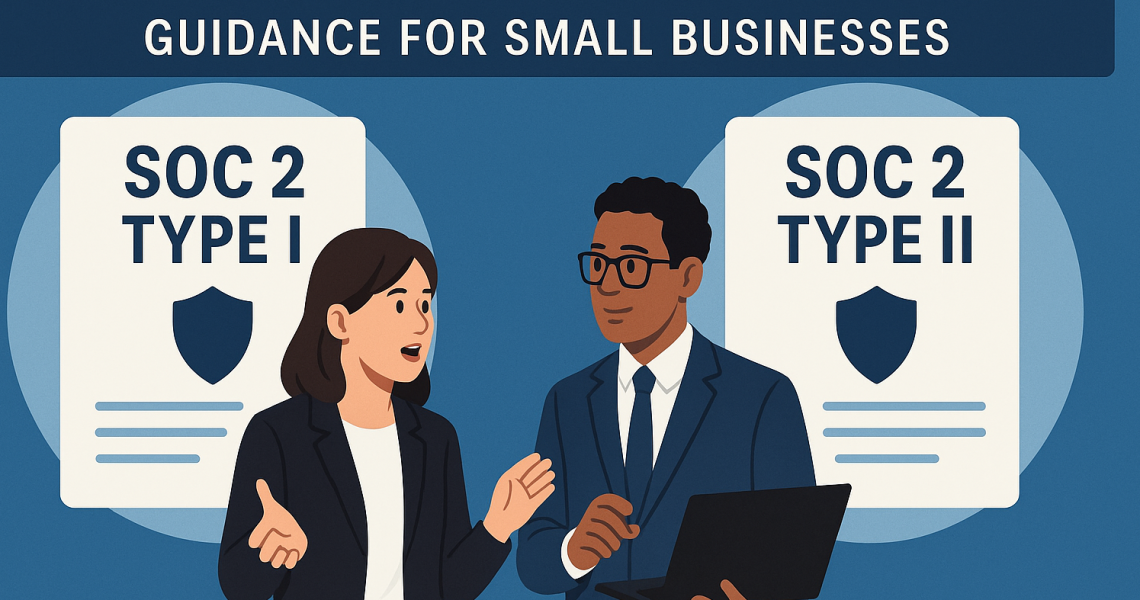
Let’s begin by clarifying a key point: SOC 2 is an attestation, not a certification. It results in a CPA firm issuing an auditor’s opinion on whether an organization’s controls are suitably designed (Type I) and/or operating effectively over time (Type II). There’s no formal pass/fail, only an evaluation against the Trust Services Criteria—which include Security (required), Availability, Processing Integrity, Confidentiality, and Privacy.
SOC 2 Type I: A Snapshot in Time
SOC 2 Type I evaluates whether the controls related to the chosen Trust Services Criteria are suitably designed and implemented at a specific point in time. It answers the question: Are the right controls in place today to protect customer data?
Characteristics:
- Faster to complete (typically 4–8 weeks).
- Useful as a starting point for companies new to security audits.
- Assures stakeholders that controls exist, but not that they have been tested over time.
When to Choose Type I:
For small businesses—especially startups—Type I is often the first logical step. It’s ideal when:
- You are early in your security program maturity.
- You need to quickly satisfy prospective clients requirements.
- You’re preparing for a future Type II but need a near-term deliverable to show progress.
Many organizations use a Type I as a stepping stone to a Type II, enabling them to build trust and close deals while further maturing their controls.
SOC 2 Type II: Proof Over Time
SOC 2 Type II attestation evaluates not only whether controls are properly designed, but also whether they operated effectively over a period of time—typically 3 to 12 months. This demonstrates a stronger, sustained commitment to security and operational excellence.
Characteristics:
- More rigorous and time-consuming (often 3–6 months minimum).
- Provides higher assurance to customers and partners.
- Requires historical evidence and operational consistency.
When to Choose Type II:
Type II becomes essential when:
- You are targeting enterprise customers, especially in sectors like fintech, healthcare, or B2B SaaS.
- Your clients demand evidence of ongoing security practices.
- You want to establish your company as a mature, trustworthy partner in competitive markets.
A successful Type II report signals that your organization doesn’t just talk about security—it lives it, continuously.
Strategic Choices for Growing Firms
From the vantage point of a fractional CISO, my advice is clear: match your SOC 2 strategy to your growth stage and client expectations. For early-stage companies, a SOC 2 Type I can open doors and build early trust. But as your operations scale and your client base becomes more discerning, SOC 2 Type II will be the bar to meet.
Both are tools to foster confidence—not just in your technology, but in your commitment to safeguarding data. Use them strategically, not just as checkboxes, but as milestones in a broader culture of security.
Need some help with SOC 2 readiness or audits? Schedule a free consultation below.